
Rarely seen as a format worth taking seriously, comics are often perceived as exclusively juvenile or humorous. More often than not, it is only seasoned comic readers that understand the medium’s unique capacity to in fact be a powerful form of communication. In the case of Josh Neufeld’s A.D. New Orleans After the Deluge and Joe Sacco’s Paying the Land, their accounts exemplify the capability of their chosen art form. In referencing the comic medium and their composition process, both authors act as a mediator between reader and survivor, bridging the gap between the comic form and journalistic record.
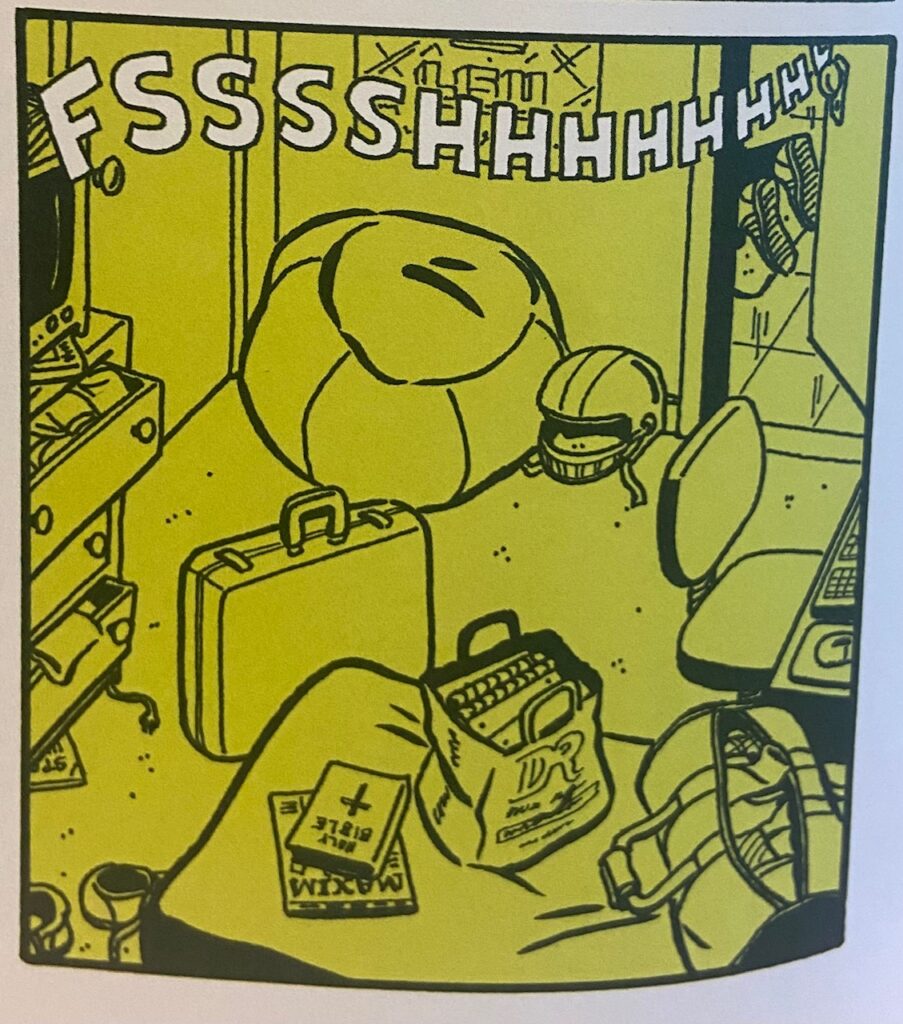
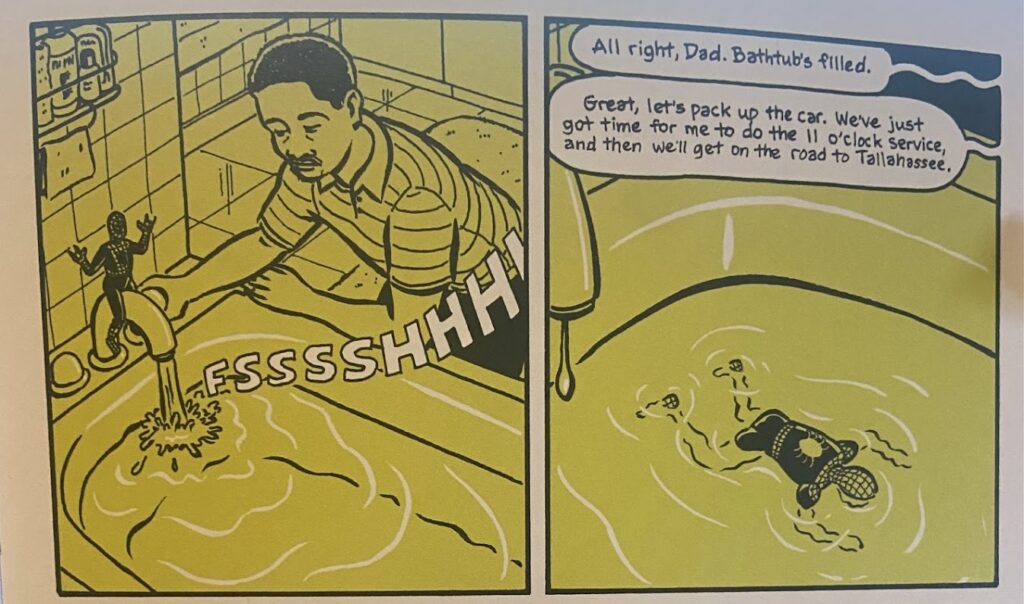
In A.D. New Orleans After the Deluge, comics present a thematic throughline in the work, wherein their fantastic iconography is contrasted with the darkly real effects of Hurricane Katrina. One such example is Spiderman as a motif, situated several times throughout the account at crucial points of certain characters’ lives. The most prominent depiction occurs in “The City”, as Kwame is running a bath in his home before eventually being forced to evacuate.
(Neufeld, 46-47)
The Spiderman action figure sits rather precariously upon the faucet head, and in an action to action panel transition (McCloud, 70) is then shown face down in the water – a chilling foreshadowing of the lives lost at the hands of Katrina. The panel on page 46 depicts a typical teenage boy’s room, with the Spiderman figure maintaining the youthful environment; the onomatopoeia moves from the first panel to the second – but then abruptly stops upon the figure’s drowning. Thus we can interpret this image as not only a message for what’s to come, but furthermore a moment that catalyzes Kwame’s loss of innocence. It is after the action figure falls into the water that Kwame and his family are thrust into the chaos of the hurricane, and is ultimately displaced from his home for three years. Being that Spiderman (and the comic medium as a whole) is more often than not seen as children’s media, the hero’s body in a helpless position has a visceral effect on the reader. Spiderman, in all of his iterations, is a young, endearing, and plucky protector of society. In reducing the icon’s size and autonomy, however, Neufeld effectively depicts the stark contrast between fantasy and reality – that no one is exempt from natural disaster, and that a comic book hero will not save us from the dangers of our tangible existence. Neufeld then carries the sentimentalism of comics to his reconnection with Leo to emphasize their importance.
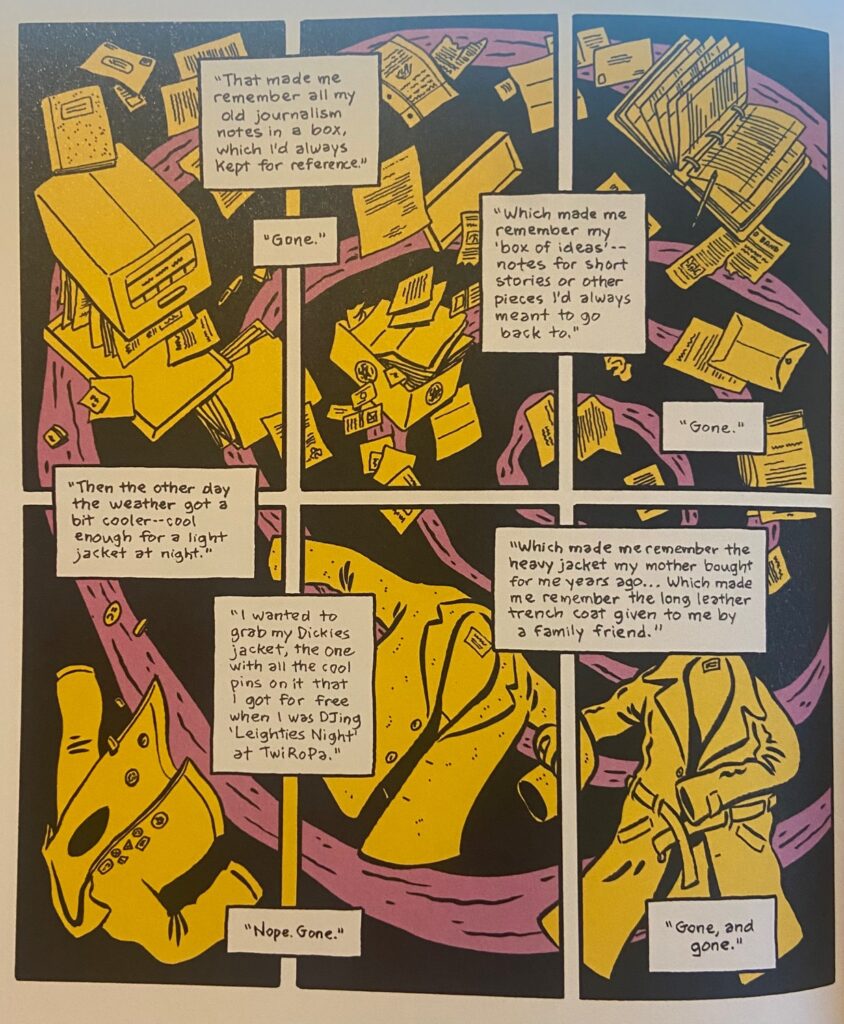
As for the author himself, Neufeld’s journalism after Katrina connects the reader more deeply to the survivors. In catching up with Leo for the second time after the hurricane, Neufeld depicts Leo’s lost belongings, including his much valued comic collection, journalism notes, and writing ideas. Filling the whole page, an array of Leo’s belongings are strewn about, with his verbal recollections arranged in a similar manner.
(Neufeld, 182)
Slicing the visualization into six separate panels, it should be noted that there are no particular panel-to-panel transitions here, and is instead one distinct visual. The author uses the comic form to mirror the nature of Leo’s loss; his material life, a once extensive collection that shaped a large part of his identity, has been detached from him. In dividing the panels and having certain sections of the gutter colored yellow, we can read this as metaphorical splitting of Leo’s life through the use of the language of comics. Going back to Understanding Comics, “the panel acts as a sort of general indicator that time or space is being divided” (McCloud, 99). Additionally, with Leo’s words now recorded as direct quotes rather than reimagined dialogue, Neufeld’s role as mediator is made more central. The visual itself only exists as a result of the author, and thus an exchange occurs between Leo’s destroyed collection and Neufeld’s surviving journalistic record; because Neufeld has taken on the task of composing the book, the dialogue between survivor and reader is opened up, and furthermore the idea of comics’ survival converges with the survival of Leo himself. It should also be noted that at this point in the account, the reader is aware of the sentimental value of comics for Leo – something that the viewer likely empathizes with themselves. Leo is a survivor that Neufeld and the reader can identify with, and their combined testimony and journalism illustrates a sincere record of the devastation of Hurricane Katrina. This element of self-referentiality is also used by Sacco to create an exchange between the author, the Dene people, and the reader.
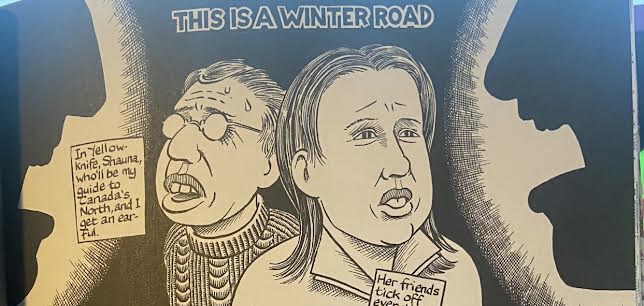
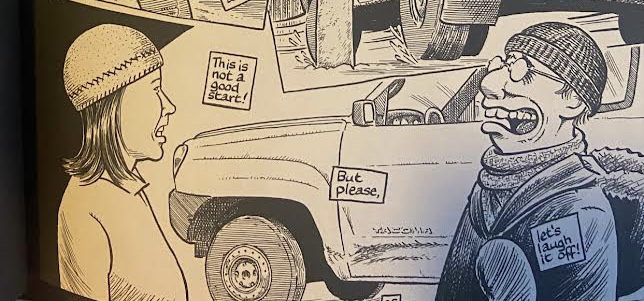
In Paying the Land, Sacco uses the visual language of comics to connect the reader to the history of the Dene people. A primary way the author does this is through the portrayal of himself – Sacco, compared to other people in the work, is the only one depicted in a more classically cartoonish style, with exaggerated features and comical expressions.
(Sacco, 25)
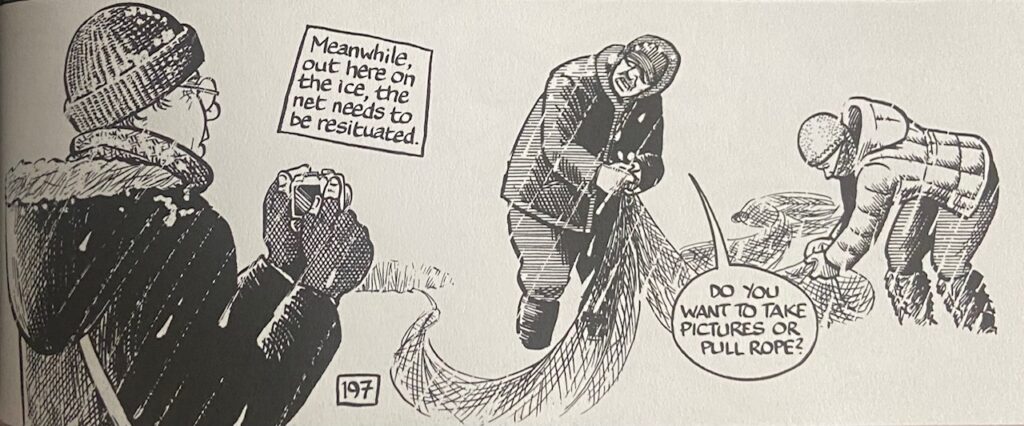
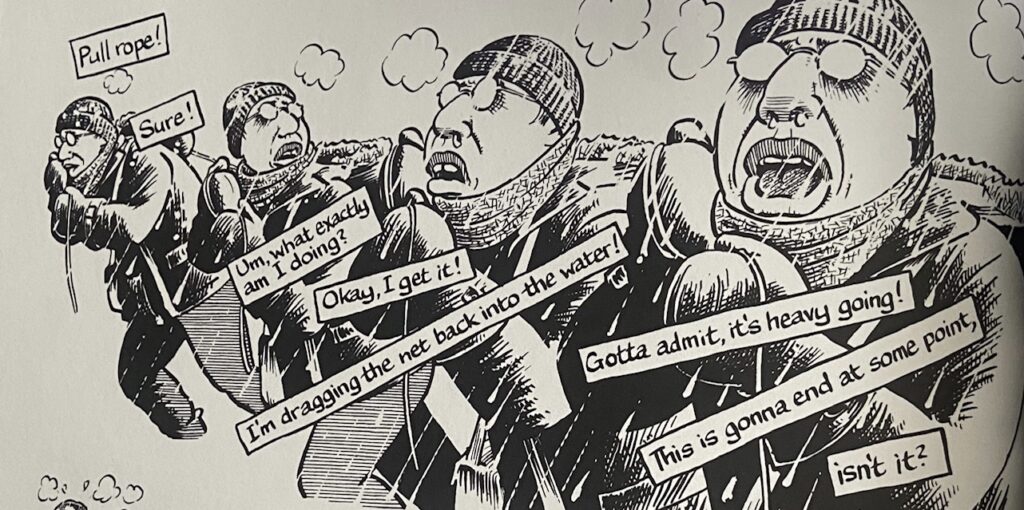
As seen above, Sacco’s expressions are almost caricatured; visual sweat beads appear to symbolize nervousness (McCloud, 130), and his mouth is twisted into an awkward forced smile. These exaggerated aspects bring the reader back to the familiar comic form, while simultaneously absorbing important historical context. Understanding Comics further elaborates on this idea, stating that “you [the reader] give me life by reading this book and by ‘filling up’ this very iconic (cartoony) form…but if who I am matters less, maybe what I say will matter more” (37). Essentially, the less realistic depiction of Sacco allows us to better identify with and listen to him. Furthermore, in documenting his research process, Sacco paints himself as a soft intellectual, unfamiliar with manual labor on the land – but willing to learn.
(Sacco, 197-198)
In doing so, the author continues to bridge the gap between survivor and reader. He is aware that his audience is most likely also living in a Western society full of development, thus making his persona relatable. When asked “Do you want to take pictures or pull rope?” however, Sacco immediately jumps into action, learning by doing – the Dene way. The act of taking pictures is of course crucial for reference in composing Paying the Land, but by participating in the Dene culture himself and then recording it, Sacco reinforces his role as a mediator, relaying the story of the Dene people in a manner that is appropriate for both the reader and the survivor. In contrast to his cartoonish depiction, however, Sacco also uses understated comic visuals to drive home the educational aspect of the work.
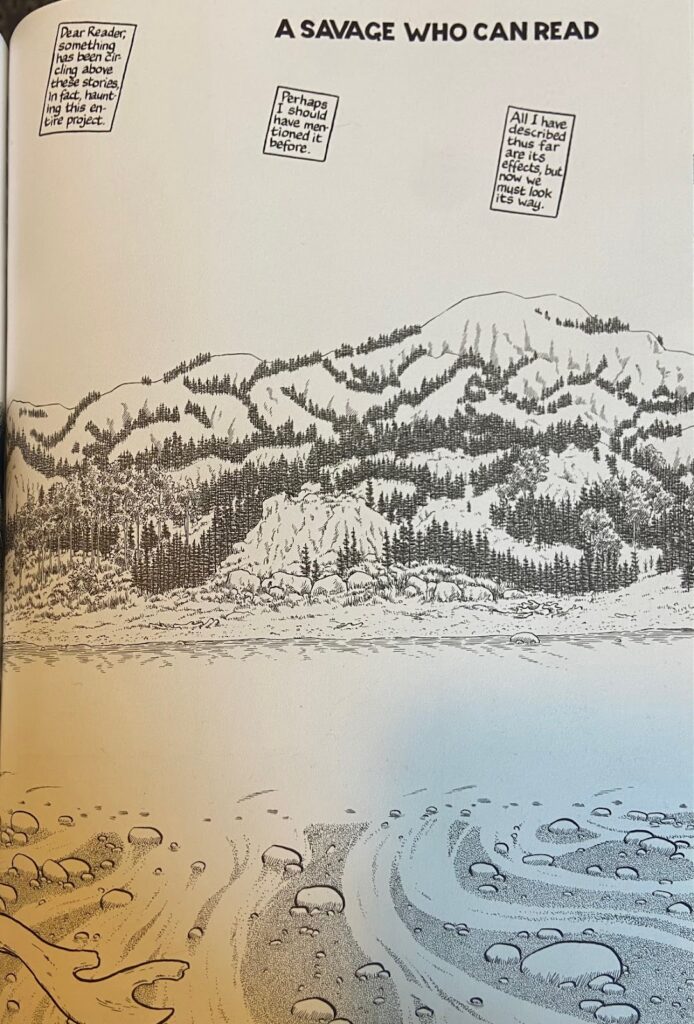
In “A Savage Who Can Read”, Sacco begins the chapter on residential schools with a full page illustration of the land. The first page is a close up view of the environment, with nature being the only subject matter. On the next page, the perspective zooms out, and the scenery is overlaid with two borders on each side, and a small plane on the right.
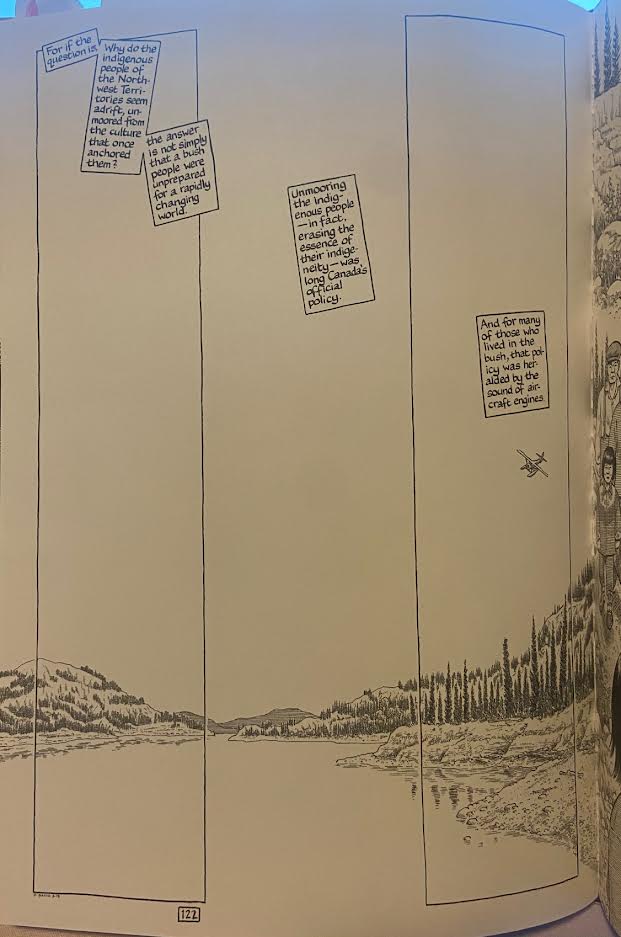
(Sacco, 121-122)
The juxtaposition of these two pages and the visual choices make a subtle but powerful statement on the “haunting” presence of planes, and what they signified to the Dene people. The first page is an unrestricted and unbounded depiction of the land – it positions the reader close to the earth, and has Sacco speaking directly to them. As put by McCloud, “when ‘bleeds’ are used…time is no longer constrained by the familiar icon of the closed panel” (103). That is to say, Sacco effectively places the reader in a timeless space, forcing them to be present in the environment and listen to his address. In the second page, however, the presence of the two borders implies a new form of being fenced in – the looming residential schools. As briefly aforementioned, the panel acts as a form of dividing space (McCloud, 99), with the space in this context of course being the land and Dene people. It is worth stating that the scenery still extends beyond the borders; the land itself and the complex history of residential schools cannot be confined by the thinly-lined rectangles. But, like the residential schools, their presence is made clear, and their stamp on the land (and its story) remains. By using the integral comic tools of bleeds and paneling, Sacco effectively relays the devastating effects of colonization to the reader.
Although not usually taken as a “serious” medium, Neufeld and Sacco exemplify how the comic format can communicate heavy content matter. Whether that be referencing the comic icon itself through Spiderman and caricatured expressions, or dividing large concepts through the panel and gutter, both authors facilitate a dialogue between reader and survivor to make comics and journalism a single compelling record. The tragedy of Hurricane Katrina and the colonization of the Dene people are two distinctly separate events, with vastly different cultural contexts and nuance; but through their depiction in comics, said nuance is handled with care and integrity.
Works Cited
McCloud, Scott. Understanding Comics: The Invisible Art. Harper Perennial, 1994.
Neufeld, Josh. A.D.: New Orleans after the Deluge. Pantheon, 2010.
Sacco, Joe. Paying the Land. Metropolitan Books, Henry Holt and Company, 2020.

true