
Although Marjane Satrapi and Art Spiegelman did not themselves suffer permanent physical trauma in their works (Persepolis and Maus respectively), they both suffer from a condition arising from their enduring existence: survivor’s guilt. With Satrapi as a witness to the material destruction of Iran and Spiegelman as the child of a Holocaust survivor, their degrees of separation from global conflict influence how they grapple with their burden, and how they relay that feeling to the reader. While both novels depict the authors’ struggles with survivor’s guilt, Satrapi’s guilt is depicted as a silent and heavy presence, whereas Spiegelman’s is expressed through his direct and cutting self-referentiality; both authors’ varying approaches force the reader to temporarily hold and understand the weight of survivor’s guilt.
Given her academic upbringing, Marji is incredibly well-versed in theory and politics throughout her childhood. Her socialist values are deeply entrenched in her – despite the fact that she benefits from a status of wealth. As a child, she already feels a sense of guilt as a result of her privilege relative to others; one early example is depicted in Image A, wherein the Satrapi family goes to visit Uncle Taher in the hospital. They are greeted at the hospital entrance by a loud request to donate blood for wounded soldiers – but the family responds with silence and avoidance. As they make their way through the hospital, Marji’s parents avert their eyes from the grim sights of those affected by the war. In contrast, Marji looks directly at them, face to face with those who are simply casualties of an oppressive system. The last three panels of Image A have no dialogue, emphasizing the scene’s heavy tension that cannot be ignored by Marji or the reader; Marji’s eye contact is made glaringly obvious, as are the tragic atrocities suffered by the wounded. As they approach Uncle Taher’s room, the entire family looks at what is (presumably) another corpse on the floor in the final panel of Image A. The weight of their privilege is made clear to Marji; she will never suffer as they do, preyed upon by the regime as a result of their poverty. This guilt is amplified when Marji is sent to live in Europe.
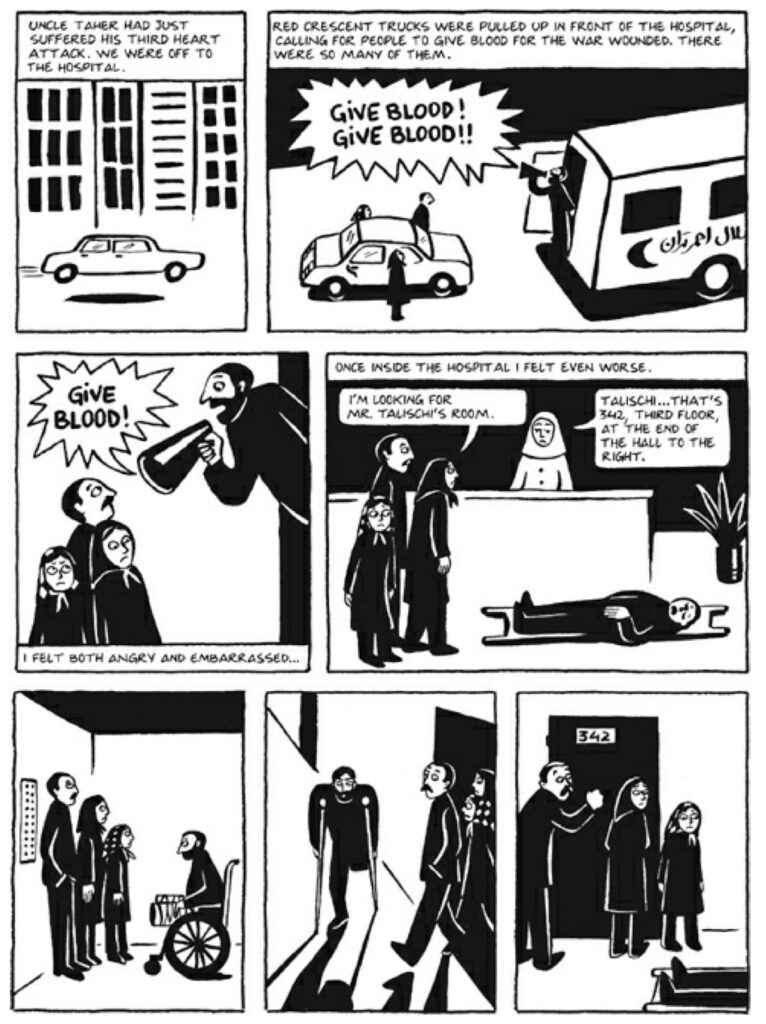
Image A (Satrapi, 121)
The physical separation from Iran and her parents proves to quiet Marjane’s once politically active voice as her guilt settles in. Marjane silences her concerns; when asked if she has been keeping up with the news, Marjane lies and says “It’s okay! I talked to my parents. They’re fine” as shown in Image B. She diverts her eyes, looking down in nervous shame. She cannot bring herself to speak of Iran, else her guilt cripples her. That being said, her vocal silence cannot suppress the guilt’s presence; also depicted in Image B is her tragic dreamscape, filled with recollections of earlier defining childhood memories. “I wanted to forget everything, to make my past disappear,” she says, “but my unconscious caught up with me”. The older Marjane looks upwards at the memories, though her eyes are closed: a failed attempt to visually shut out her survivor’s guilt. In Satrapi’s use of visuals from earlier chapters, she both expresses the viscerality of Marjane’s experiences while also forcing the reader to recall and relive their experience as a witness to Marjane’s story. The author’s confrontation with her survivor’s guilt then occurs when she returns to Iran.
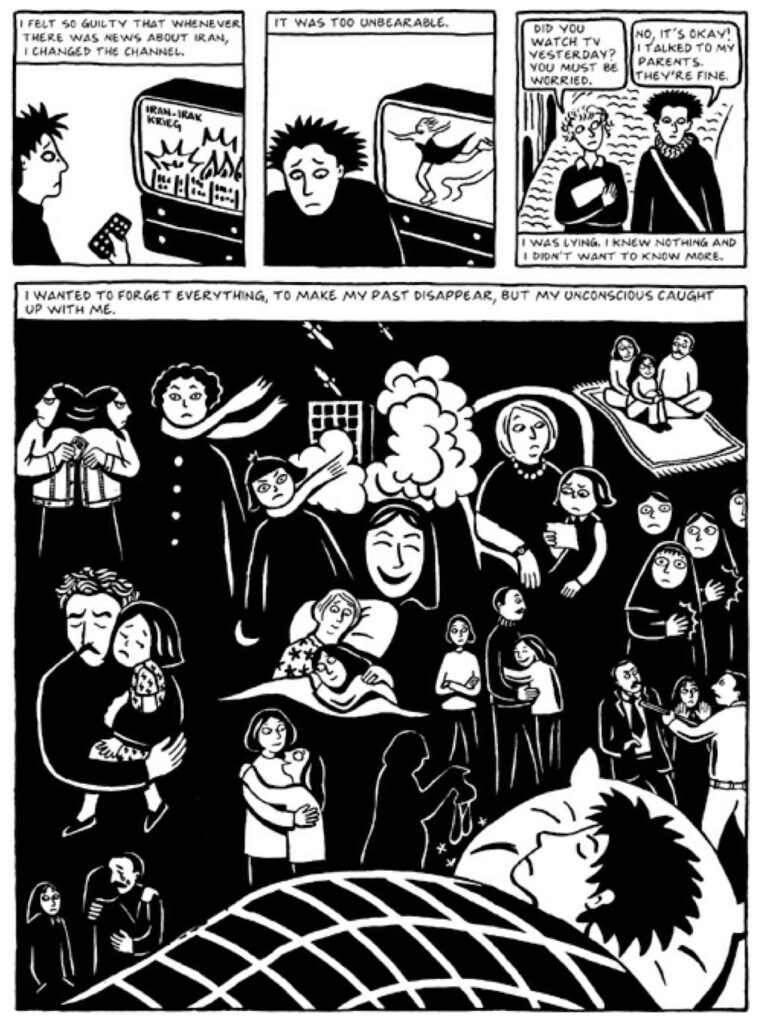
Image B (Satrapi, 194)
Having returned home after her break up with Marcus, Marjane is thrust back into the dark reality of living under the fundamentalist regime. Reunited with her family and surrounded by an environment she previously sought to forget, she can no longer deny the state of her country, or the burden of her guilt. As Marjane catches up with her father (shown in Image C), she solemnly asks how dissidents were killed. In the first panel she looks painfully at her father, prepared to face the reality that she has ignored during her time in Europe. Upon hearing his response (that “no one knows exactly how many” were killed”, Marjane puts her head in her hands and closes her eyes in the following panel, saying nothing. With a sense of resignation, she asks how many victims died in the war. Her father relays to her the numbers, as well as the grim truth that there are countless ways in which the community has been devastated by the war. As she receives this information, Marjane maintains her physical position, with her head in her hands, looking down, showing only a partial side profile to the audience. The guilt hits her at full speed. In stark contrast, her father stares coldly and blankly out past the reader. He rattles off a list of war victims in the last three panels of Image C : “…[T]he orphans, the widows, the refugees, the material destruction…”. The bags under his wide eyes, coupled with his words, portray a man who has no option but to face his own survivor’s guilt. He is not indifferent to it – but as he has witnessed these atrocities first hand unlike his daughter, he is more capable of confronting his guilt, and coming to terms with it.
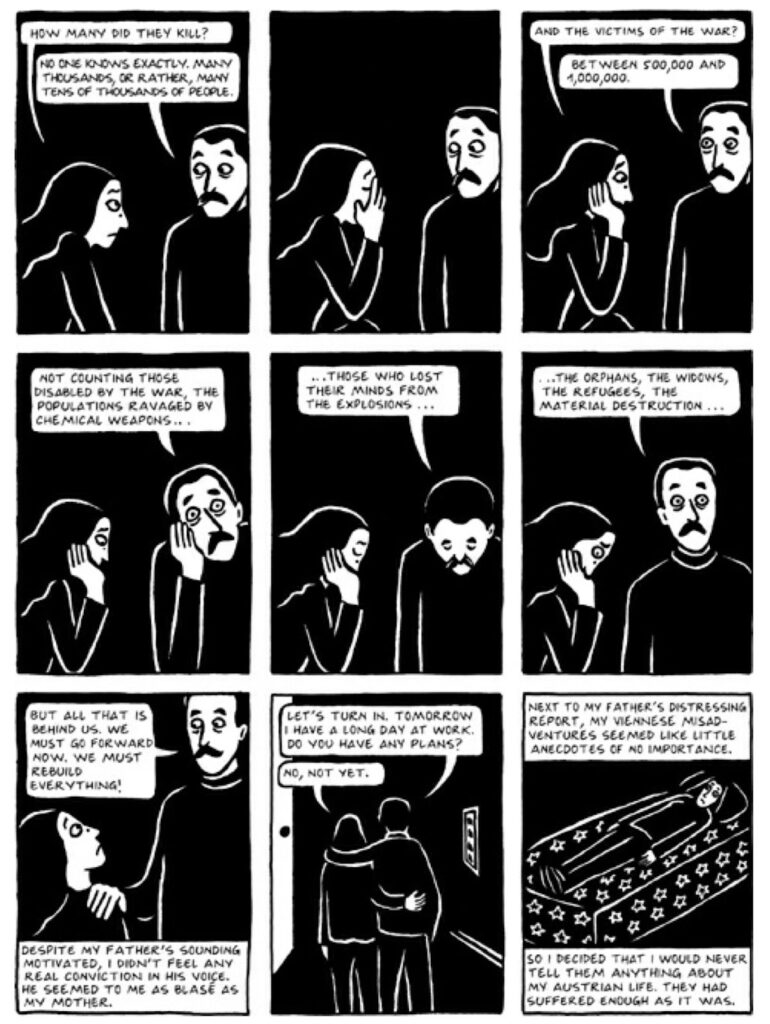
Image C (Satrapi, 257)
Satrapi’s approach to depicting her survivor’s guilt rests in her ability to create a tense and heavy environment through the use of silence. As put by Scott McCloud in Understanding Comics, “When the content of a silent panel offers no clues as to its duration, it can also produce a sense of timelessness. Because of its unresolved nature, such a panel may linger in the reader’s mind. And its presence may be felt in the panels which follow it” (102). The lack of dialogue or an explicit explanation for a certain image encourages the reader to fully absorb the illustrations and their implications – or perhaps even put themselves in Marjane’s position. “By constructing whole images based on these fragments, readers are performing closure” (McCloud, 87); that is to say, the reader must make an interpretation, as no explanation is provided. Satrapi uses this to ensure her readers feel the weight of her guilt, rather than just reading it. In contrast, Spiegelman refers to the novel and himself to implicate the reader and forcefully recognize his guilt.
Although not a firsthand victim of the Holocaust, Art Spiegelman still suffers from survivor’s guilt as the child of two survivors. This topic is revisited throughout the novel, but one of the most prominent representations of his guilt arrives in “Prisoner on the Hell Planet”. Portraying Art’s struggle with the guilt of his mother’s suicide, the comic comes as an abrupt tone change – both content wise and visually. As he recalls the last time he spoke to her (seen in Image D), the reader is faced with an art style that is exaggerated and macabre, and dialogue that feels much more personally painful: both in contrast to the style of Maus. The reader is blanketed by a feeling of pity and unease, for both Art and his mother. In depicting himself as a prisoner, Spiegelman directly attributes his survivor’s guilt as a burden that holds him captive. The final three panels of Image D show Art being locked away, as the perspective zooms out to show an indeterminate amount of cells. He blames his mother for his guilt, saying “you murdered me, mommy, and you left me here to take the rap!!”. The addition of “Prisoner on the Hell Planet” provides an even deeper level of Spiegelman’s vulnerability, but more notably it is the depiction of Vladek’s discovery of the comic that adds layers to the author’s survivor’s guilt. Originally published as an underground comic, Art is acutely aware that it would hurt his father, and likely retrigger painful memories of Anja. This is a compounding of Spiegelman’s guilt through self-reference; the insertion of “Prisoner on the Hell Planet” depicts his survivor’s guilt in the wake of his mother’s death, which then increases upon Vladek’s discovery of the comic, and finally the guilt that follows in recording the incident in Maus.
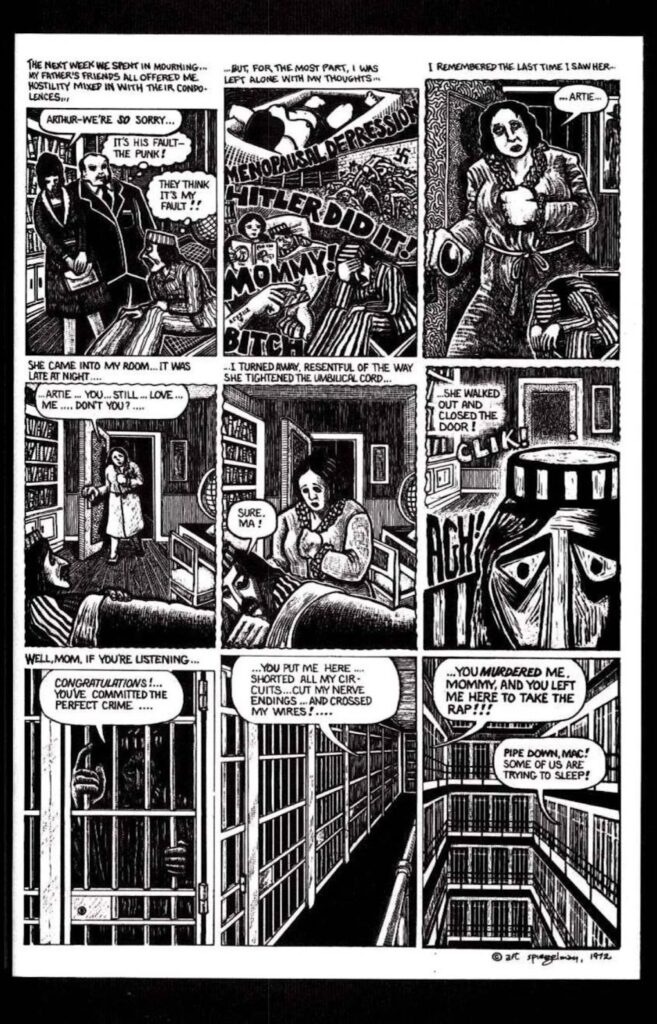
Image D (Spiegelman, 103)
In Maus II, Art reflects on the success of Maus I, and considers the implications of that success, as seen in Image E. Sitting at his drawing board, Spiegelman depicts himself as a human with a mouse mask, rather than his previous anthropomorphized persona; he maintains his image, but nonetheless offers the reader another glimpse into his true humanity, reminding them that he is not just a voice attached to a character. The dark shading and weariness visible on the mouse mask works in tandem with the solemn speech bubbles, as Art reflects on the contrasting essences of life and death that surround him. The bottom panel of Image E shows Art slouched over his drawing board, atop a pile of corpses, while the page buzzes about with flies. In referencing the dates of his parents’ death and incidents of the Holocaust, and juxtaposing them with the dates of Maus I’s success and the incoming birth of his daughter, the pile of bodies becomes a clear indicator of Spiegelman’s guilt. The implication is made that his success (he feels) is in part reliant on the death of millions of innocent people, in addition to his own parents. In discussing his complex feelings on the novel itself, Spiegelman encourages the reader to hold the medium itself as a physical manifestation of survivor’s guilt – not just to read about it.
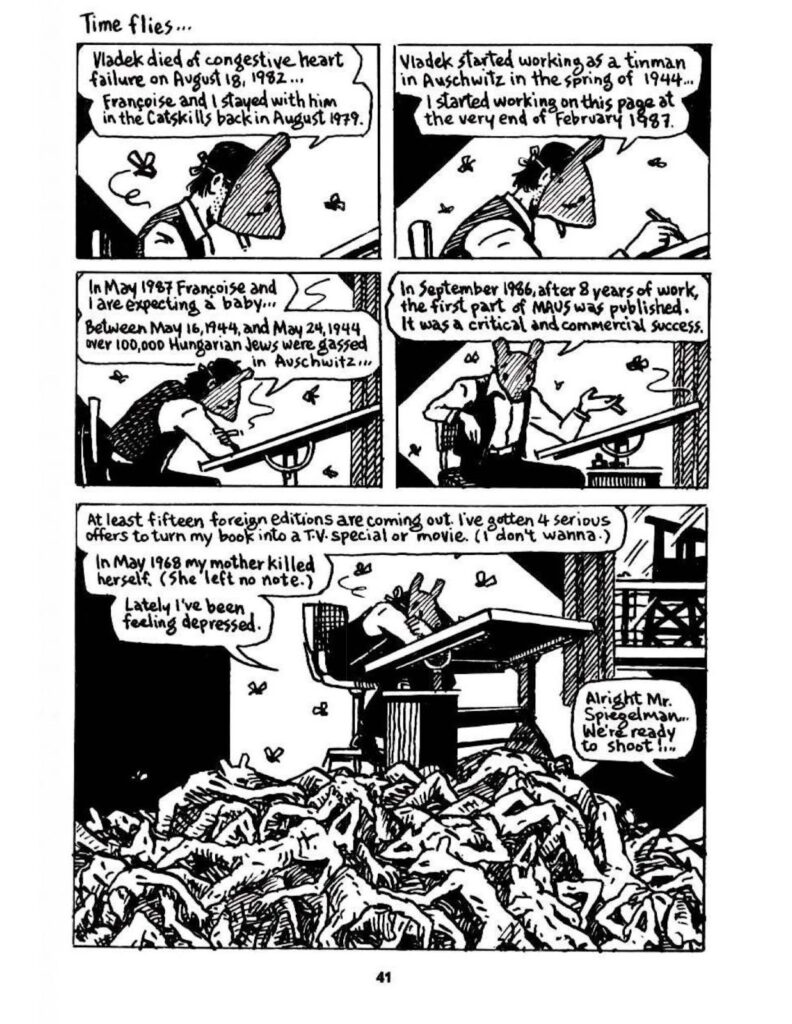
Image E (Spiegelman, 41)
Whereas Satrapi uses silence to convey the burden of survivor’s guilt, Spiegelman’s self-referentiality directly addresses the text’s form and the reader itself, thus implicating them as a component of the author’s guilt. The words and dialogue are almost uncomfortably direct – speaking to the reader almost as a confidant and a participant in the writing process. This approach works alongside the simple art style to increase the impact of the text. As put by McCloud: “Who I am is irrelevant. I’m just a little piece of you. But if who I am matters less, maybe what I say will matter more” (37). By constantly referring to the novel itself in an approachable art style, Spiegelman’s survivor’s guilt is both understood and held by the reader.
Although Satrapi and Spiegelman’s tactics when depicting their survivor’s guilt vary greatly, both authors nonetheless force the reader to confront, interrogate, and feel its weight. Persepolis’ use of silent panels and the positioning of her gaze creates a somber and heavy tone to ensure the reader absorbs the feeling of survivor’s guilt. Conversely, Spiegelman’s self-referential vulnerability grabs the reader’s attention, and implicates them as a part of his guilt. Despite the fact that the burden of survivor’s guilt is a melancholy force, Dori Laub offers us this: [i]t is the encounter and the coming together between the survivor and the listener, which makes possible something like a repossession of the act of witnessing” (85) – and readers can take solace in the idea their viewership contributes to the important act of witnessing the author’s story.
Works Cited
Felman, Shoshana, and Dori Laub. “An Event Without a Witness: Truth, Testimony and Survival.” Testimony: Crises of Witnessing in Literature, Psychoanalysis, and History, Routledge, 1992, pp. 75–92.
McCloud, Scott. Understanding Comics: The Invisible Art. Harper Perennial, 1994.
Satrapi, Mariane. The Complete Persepolis. Pantheon Books, 2007.Spiegelman, Art. The Complete Maus. Penguin Random House, 2003.
